Helen Cook
Australian Mum by Day, Nuclear Energy Lawyer by Night
After finishing my degree in law at Sydney University in 2004, I went backpacking, as many Australians do, travelling through Southeast Asia, Europe, and North Africa. An intended six months away from Australia turned into 18 months as I interned in the Netherlands with the International Criminal Court and the Criminal Tribunal for the former Yugoslavia. I eventually found myself back in Australia and working at a corporate law firm. In 2007, desiring to live abroad again, I moved to Dubai with the law firm Freshfields Bruckhaus Derringer and worked on general energy and infrastructure developments in the Middle East and North Africa.
I remember very clearly the day I accompanied the head of Freshfields’ Middle East and North Africa region to a meeting in Bahrain, which ended up being a turning point in my career. It was the first meeting of Bahrain’s newly formed National Committee on Nuclear Energy, tasked with considering the implementation of a nuclear energy program. At that time, the United Arab Emirates was already planning for nuclear energy. While residing in the UAE, I had a front-row seat to the ambitious, forward-thinking endeavor being undertaken by the country, and over the next couple of years, working on Bahrain’s fledgling nuclear energy program, I developed an intellectual interest in nuclear law and an appreciation for nuclear technology. I quickly became hooked. I decided to specialize, and I’ve worked in the nuclear sector ever since. It was a crazy thing to do at the time, but I even wrote a textbook, The Law of Nuclear Energy, the first edition of which was published in 2013. The fourth edition is coming out later this year.
After the UAE, I headed to Washington, D.C. Over the next eight years, I worked at two international law firms, Pillsbury and Shearman & Sterling, on a variety of nuclear projects and transactions and advised multiple stakeholders in the sector all over the world. In 2018, I decided to leave the world of “big law” and establish my very own small law firm dedicated to the civil nuclear sector, Global Nuclear Energy Advisory (GNE Advisory).
At GNE Advisory, our work ranges from advising nuclear newcomer countries on early-phase policy development (bilateral agreements, drafting comprehensive nuclear laws, and helping set up nuclear regulatory structures) to the procurement and construction of large nuclear power plants and the demonstration of small modular reactors.
My move from the United States to Australia at the start of the global pandemic was driven largely by my desire to start a family. It was important to me that my girls, born through the miracle of IVF with donor sperm, would be close to their grandparents and my “home” support network. However, considering nuclear energy is currently prohibited in Australia and that Australia is quite geographically isolated, it is arguably one of the worst places in the world from which to run a nuclear energy law firm! I make it work—I often find myself being a “mum by day” and a “nuclear energy lawyer by night,” when my clients in the Middle East, Europe, and the United States come online.
More recently, of course, nuclear energy has been, and is currently being, debated in my home country. I’ve found it positive that, despite our prohibitions, the majority of Australians are now curious about nuclear energy and self-declare that they need to know more to inform their opinion. Most Aussies didn’t know of the research reactor on the outskirts of Sydney or the benefits it brings through nuclear medicine. Many wouldn’t have known that we export our uranium to the world and have the largest known reserves of any country. Before our debate commenced, most Australians would probably not have appreciated the role that nuclear energy is expected to play in the decarbonized energy systems of other countries and regions.
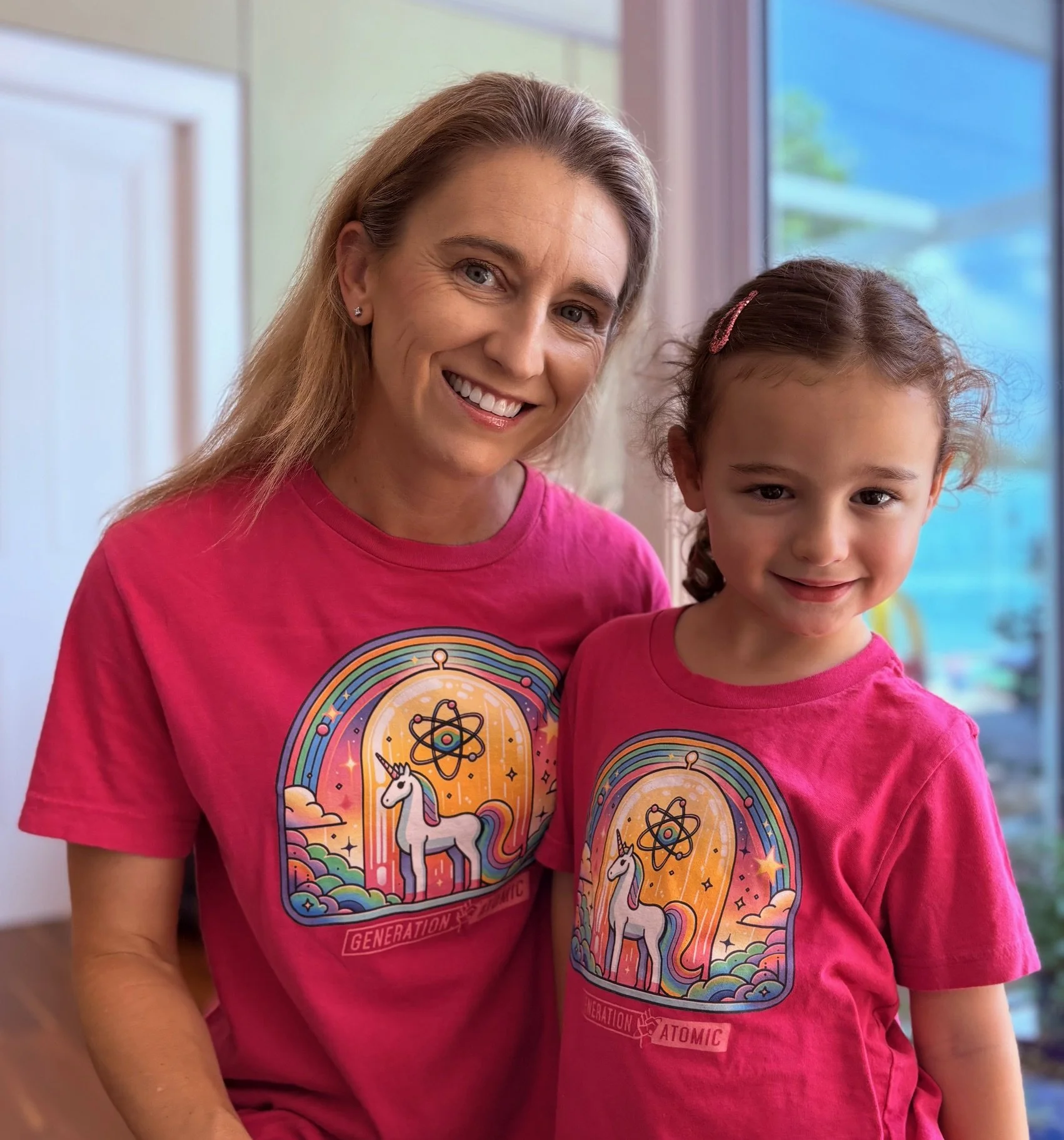
Generation Atomic shirts! https://shop.generationatomic.org/
I have sought to engage in our debate, drawing on my international experience and explaining the approaches of other countries, as well as discussing how we could move forward with a nuclear energy program. I’ve pointed out that Australia is increasingly out of step with other industrialized countries and that many countries in our region have plans to introduce nuclear energy in the very near future. At a time when we need all sources of low-carbon energy generation available to us, Australians are prohibited from accessing a proven and reliable source of clean energy. This must change, and quickly. I believe it is essential that nuclear energy optionality be ensured because, just like so many other countries, we will also need access to this energy source as an important part of our future decarbonized energy system. If we can overcome the political hurdle, we are well-placed as a nation to implement a nuclear energy program.
I’m sure lots of pro-nuclear mothers want “nuclear” to be among their kids’ first words. I was certainly one of those mums! “Nuclear” was in my girls’ vocabulary very early on and both say it with gusto! Of course, my key motivator is indeed my girls and my desire to see an energy future that is sustainable, reliable and affordable for generations to come. I continue to hope that we will have many more people saying “nuclear” with Aussie accents and as much positivity as my little ones!